


Broken Spring Repair Example for Garage Doors
- Mike Davis
- May 13
- 6 min read

A garage door can work fine at 7 a.m. and be dead weight by 7:15. That is usually how a broken spring repair example starts - the door was normal yesterday, and now it will not open, feels unusually heavy, or slams shut when someone tries to move it. For most homeowners and property managers, the problem shows up with no warning and immediately turns into a safety issue.
If that sounds familiar, the first thing to know is simple: do not keep forcing the door. A broken spring is not a small adjustment. It changes the balance of the entire system, and that can damage the opener, bend hardware, or put someone at risk of injury. Fast service matters here because the door is no longer doing its job safely.
A real broken spring repair example
Here is a common service call. A homeowner backs out for work, hits the wall button to close the garage door, and later comes home to find the door only lifting a few inches before stopping. The opener strains, the top section shakes, and there is a loud gap visible in the torsion spring above the door.
That gap is the giveaway. Torsion springs are mounted on a shaft above the garage door and carry the load that makes the door feel manageable. When one snaps, the counterbalance is gone. On a double-wide residential door, that can leave the opener trying to lift hundreds of pounds it was never designed to handle by itself.
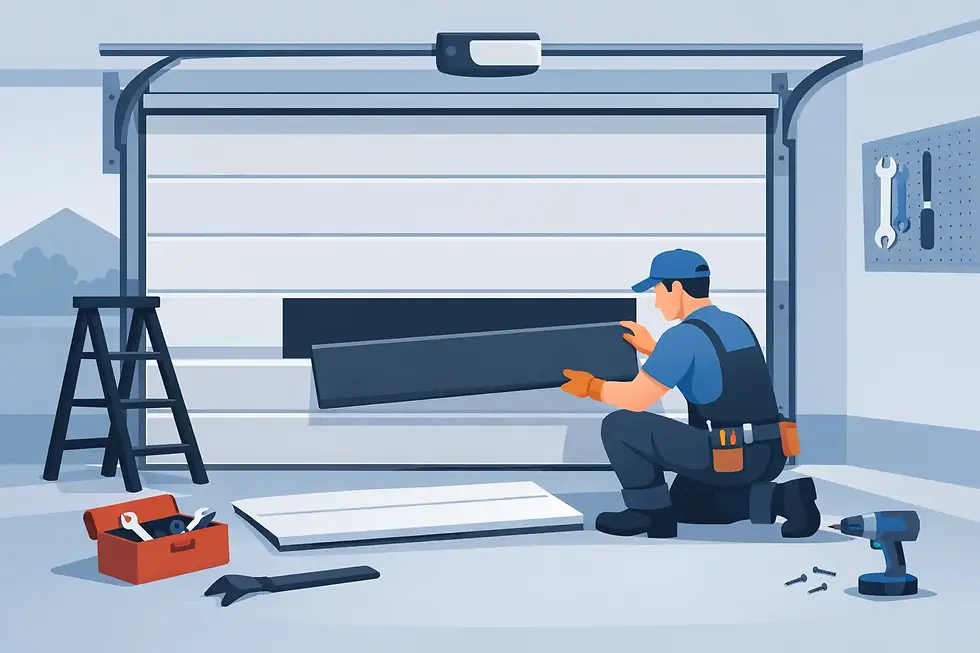
In a standard service visit, the technician first confirms the spring failure and checks whether anything else was damaged when the spring broke. That includes the center bearing, end bearings, cables, drums, shaft, hinges, rollers, and opener arm. This part matters because a broken spring does not always fail alone. If the cables came off the drums or the door went crooked, the repair scope changes.
Next comes securing the door in place. If the door is stuck open, it has to be stabilized before any work begins. If it is closed, the technician will keep it from shifting while removing the broken spring components. Then the correct replacement spring is selected based on the door height, weight, drum size, and track setup. Using a spring that is merely close enough can create a new problem right away. The door may fly open, drop too fast, or wear out the opener early.
Once the new spring is installed, the system is tensioned and balanced. That balance test is the part many people never see, but it is what tells you whether the repair was done right. A properly balanced door should stay near mid-travel when lifted by hand, move smoothly, and not force the opener to fight the weight of the door. After that, the hardware is tightened, moving parts are checked, and the opener is tested again.
What this broken spring repair example shows
The repair itself is not just about swapping one part. The spring is tied to every major moving piece on the door. That is why two jobs that look similar from the driveway can end up being very different once the inspection starts.
Sometimes the fix is straightforward - one broken torsion spring, one matched replacement, quick balance, done. Other times, the broken spring exposed worn cables, bent brackets, or an opener that was already overworked. If the door was operating out of balance for weeks before the spring finally snapped, the extra strain often shows up elsewhere.
That is also why pricing can vary. Customers want a fair number, and they should. But honest pricing depends on what is actually wrong, not a guess made before anyone sees the door. A good on-site estimate should explain whether the job is spring-only or whether the failure caused related issues that need attention now.
Signs your spring may be broken
Most people do not inspect their garage door springs until something fails. Fair enough. Still, there are a few signs worth noticing before the door stops completely.
A loud bang from the garage is a common one. Many customers describe it as sounding like something hit the house. That is often the spring breaking under tension. Another sign is a door that suddenly feels heavy, opens a few inches and stops, or starts closing much faster than usual. You may also notice a visible separation in the torsion spring or slack in the lifting cables.
Extension spring setups can show different symptoms. These springs run along the horizontal tracks, and when one breaks, the door may lift unevenly or hang crooked. In either case, the rule stays the same: stop using the door until it is inspected.
Why springs break in the first place
Most broken springs come down to cycle life. Every open and close counts as one cycle, and springs wear out after enough repetition. If your garage door is the main entrance to your home, those cycles add up fast.
There are other factors too. Rust can shorten spring life by increasing friction. Poor balance can overwork one side of the system. Wrong-size replacement springs from a previous repair can wear out early because they were never matched correctly to the door. Cold weather can also expose a spring that was already near the end of its life.
Commercial doors have their own version of this problem. A roll-up or sectional overhead door used all day will burn through spring cycles much faster than a typical residential door. For business owners, that means spring failure is not just an inconvenience. It can interrupt deliveries, security, access, and workflow immediately.
DIY is where simple problems turn expensive
People are capable. That is not the issue. The issue is stored tension. Garage door springs hold serious force, and that force has to be controlled the right way during removal and winding. One slip with the wrong tools or technique can cause major injury.
There is also the problem of misdiagnosis. A homeowner may think the spring is the only issue, replace a part, and still have a crooked door because the cable came off or the shaft shifted. Then the opener gets used again, and now the repair is larger than it was at the start.
For that reason, broken spring work is one of the clearest cases for professional service. It is faster, safer, and usually cheaper than fixing the damage that comes from trying to muscle through it.
What to expect from same-day service
If your car is trapped inside the garage or your commercial door will not secure, waiting around is not a realistic option. Same-day service should mean a real inspection, a clear explanation, and a repair plan that gets the door working safely again without the sales pitch.
That matters to customers across St. Louis because most are not shopping for a long lecture. They want the door fixed, the price explained, and the work done correctly the first time. Family-owned local service tends to work better for that kind of job because the focus stays on the repair, not on upselling a full replacement every time a spring breaks.
A trustworthy company should also be clear about trade-offs. If the second spring is not broken yet but both are the same age, replacing both may make sense. If the door sections are in good shape and the opener is still sound, a spring repair may be all you need. It depends on the condition of the full system, not on a one-size-fits-all answer.
When repair is enough and when replacement makes sense
A broken spring does not automatically mean you need a new garage door. In many cases, a spring replacement and balance adjustment restore normal operation the same day. That is the cost-effective answer when the rest of the system is still solid.
But there are times when the spring failure is part of a bigger pattern. If the door is badly damaged, severely rusted, off-track repeatedly, or paired with worn components throughout, replacement may save money over repeated repair calls. The key is having someone explain that honestly, with no pressure.
That service-first approach is why many customers call Davis Door Service when the door quits without warning. They want a local crew that shows up fast, gives a straight answer, and stands behind the work.
If your garage door is heavy, stuck, crooked, or making the opener work harder than it should, treat it like the safety problem it is. The right repair is usually quick once the cause is confirmed, and the sooner it is handled, the better your chances of avoiding bigger damage.


Comments