


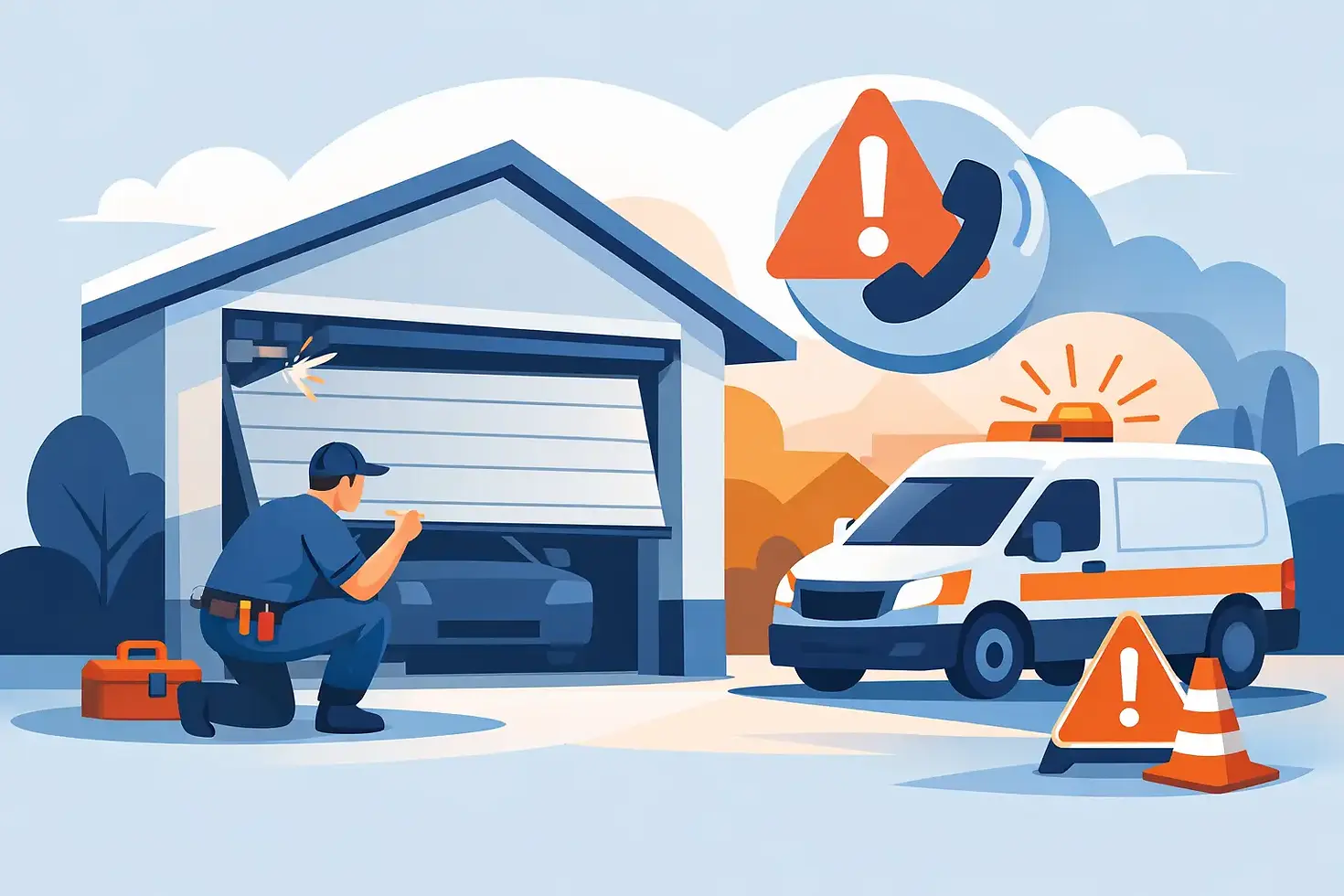
Garage Door Emergency Service Guide
- Mike Davis
- May 5
- 6 min read

A garage door never seems to fail at a convenient time. It happens when you're late for work, trying to close up for the night, or opening a commercial bay before customers arrive. This garage door emergency service guide is built for those moments - when the door is stuck, crooked, loud, off track, or clearly unsafe, and you need to know what to do right now.
The first thing to understand is simple: not every garage door problem is a true emergency, but some absolutely are. If a door is trapped halfway open, hanging unevenly, slammed shut, or making grinding and snapping sounds, treat it like a safety issue first and a repair issue second. A heavy overhead door under spring tension is not something to test by trial and error.
What counts as a garage door emergency
A real emergency usually comes down to safety, security, or lost access. If your car is stuck inside and you need to leave, that is urgent. If the door will not close and your home or business is left open, that is urgent too. If the door is off track, a cable has snapped, a spring has broken, or the bottom section is bent badly enough that the door may collapse, stop using it immediately.
There are also cases that feel urgent but may not require after-hours repair. A noisy door, slow opener, worn rollers, or minor panel dent can usually wait for a scheduled service visit unless the system is becoming unstable. The hard part is knowing the difference. If the door looks crooked, feels unusually heavy, or will not stay in position, it has moved past routine maintenance.
Garage door emergency service guide - what to do first
Start by clearing people, pets, and vehicles away from the door. Do not stand under it, do not try to race it shut, and do not keep pressing the opener button to see if it will "push through." That often makes damage worse, especially with broken springs, damaged tracks, or a failing opener.
Next, look without touching. A visible gap in the torsion spring, a dangling cable, rollers out of the track, or a door leaning to one side are strong signs the system is under stress. If you smell something hot near the opener or hear humming without movement, stop running the motor. That can burn out the opener and still leave the actual mechanical problem unresolved.
If the door is fully closed and not opening, leave it closed until a technician can inspect it. If it is fully open and appears unstable, keep the area clear and call for service right away. If it is halfway open, that is often the worst position because the door may be carrying uneven weight.
You can check the basics safely from a distance. Make sure the opener has power. Replace remote batteries if needed. Confirm the lock is not engaged by mistake. If your photo eyes are blocked by dirt or debris and the door reverses while closing, cleaning the lenses may solve it. But if the issue involves springs, cables, tracks, drums, or the door balance, that is not a DIY repair.
Problems that need immediate professional service
Broken springs top the list. Torsion and extension springs do the heavy lifting, and when one breaks, the door may become dead weight or jerk violently during operation. Trying to lift it yourself can cause injury or bend other components.
Snapped cables are another major warning sign. A cable can fray slowly or fail all at once. Once it goes, the door may hang crooked or jam in place. Running the opener at that point often twists the door, damages the track, or pulls other hardware loose.
An off-track door is never a wait-and-see problem. Rollers can pop out from impact, worn hardware, or tension issues. The door might still move a little, but that does not mean it is safe. One more cycle can bring the whole assembly down hard.
Commercial properties have an extra layer of urgency. A stuck roll-up or overhead door can stop deliveries, lock out staff, expose inventory, or interrupt daily operations. Fast service matters because downtime costs money fast.
What you should never do in an emergency
Do not loosen spring hardware. Do not cut cables. Do not remove brackets attached to the bottom of the door. Those components are tied into high tension, and a mistake there can go bad in a hurry.
Do not force a jammed door open with a vehicle, pry bar, or extra people pulling together. That may sound obvious, but it happens more often than you would think. It turns a repair into a much bigger one.
Also, do not assume the opener is the real problem just because the wall button is not working. Many emergency calls that look like opener failures are actually spring breaks, track issues, or door balance problems. Replacing the motor without fixing the root cause wastes time and money.
When manual release helps - and when it doesn't
The emergency release cord can be useful, but only in the right situation. If the opener is the issue and the door is otherwise balanced and intact, releasing it may let you move the door by hand. That can help if you need to get a vehicle out.
But if a spring has broken, a cable has snapped, or the door is crooked, pulling the release can make the door dangerous to handle. It may drop suddenly or become too heavy to control. If you are not sure what failed, do not guess.
That is where experienced emergency service earns its keep. A trained technician can tell in minutes whether the problem is electrical, structural, or tension-related and make the right repair without adding more damage.
How emergency service should work
A good emergency call should feel straightforward. You explain what the door is doing, when it failed, and whether it is stuck open, closed, or off track. From there, the goal is fast dispatch, a clear arrival window, and a technician who shows up ready to fix the issue - not sell you things you do not need.
That matters in St. Louis, where weather swings, daily schedules, and business hours do not leave much room for delays. A family trying to secure their home at night and a business trying to open on time both need the same thing: fast, honest service from someone who knows garage doors inside and out.
In many cases, the immediate repair is the right move. In others, it depends on the age of the door, parts availability, and overall condition. A single broken spring on an otherwise healthy door is usually a repair. A badly damaged older system with worn rollers, bent track, and opener strain may be better handled with a broader fix. The key is transparency. You should know what failed, what it costs, and whether the repair is likely to hold.
How to choose the right emergency garage door company
Speed matters, but it should not be the only factor. You want a company that offers true 24/7 emergency service, same-day availability when possible, and direct answers on pricing and repair options. Owner-operated service often makes a difference here because the focus stays on getting the door working, not pushing upgrades.
Look for a company that handles both residential and commercial systems, because emergency repairs often involve more than one trade skill. Springs, cables, openers, tracks, roll-up doors, and sectional doors all fail differently. The technician should already know that before arriving.
Guarantees matter too. If a company is confident enough to stand behind the work and keep pricing simple, that tells you a lot. Davis Door Service has built its name around that kind of direct accountability - fast response, fair pricing, and no salesman routine when you just need the problem fixed.
Preventing the next emergency
Not every emergency can be avoided, but plenty can. Doors usually show warning signs before they fail completely. Jerky movement, loud popping, sagging sections, frayed cables, delayed opener response, and uneven travel are all signals to schedule service before the situation turns urgent.
For homeowners, an annual tune-up can catch worn parts early. For commercial doors that cycle often, inspections may need to happen more regularly. It depends on usage, age, and environment. A door used four times a day does not wear like one used forty.
If your garage door is acting up right now, trust what you are seeing. A stuck, uneven, or unsafe door is not something to put off until the weekend. The right move is usually the simplest one - stop using it, keep the area clear, and get a qualified technician on the way before a bad problem becomes a bigger one.


Comments