


When Replace Garage Door Springs
- Mike Davis
- Apr 29
- 6 min read

A garage door usually gives you a little warning before the springs quit. The door gets heavy. It jerks on the way up. It slams shut faster than normal. If you are wondering when replace garage door springs, the short answer is this: replace them when they show wear, lose tension, break, or start making the door unsafe to use.
That sounds simple, but real life is not always that clean. Some springs fail all at once with a loud snap. Others weaken over time and make your opener work harder for weeks before anyone realizes what is happening. If your garage door is struggling, crooked, noisy, or stuck, the springs need attention now, not later.
When to replace garage door springs
Garage door springs are what actually lift the weight of the door. The opener is not doing the heavy lifting by itself. It is guiding a door that should already be balanced by the spring system. When the springs wear out, the whole setup starts fighting itself.
Most residential springs are rated for a certain number of cycles. A cycle is one full open and close. That means lifespan depends on how often the door gets used. A household that uses the garage as the main entry point will burn through springs faster than one that only opens the door on weekends.
In practical terms, many springs last around 7 to 12 years. But age alone is not the deciding factor. Usage, humidity, temperature swings, door weight, and whether the springs were sized correctly all matter. A newer spring can fail early if the door is too heavy or the parts were poorly installed. An older spring can keep going if the system has been maintained well.
The real answer to when replace garage door springs is based on symptoms, balance, and safety.
Signs your garage door springs need replacement
A broken spring is obvious sometimes, but not always. Homeowners often call because the opener stopped working, when the real problem is a failed spring. Property managers see doors that still move, but barely. Commercial operators may notice slower performance, harder starts, or uneven travel before a full breakdown.
If the door feels unusually heavy when you try to lift it manually, that is one of the clearest signs. A properly working spring system should let the door move with controlled resistance, not dead weight. If it suddenly feels like lifting a wall, stop using it.
A door that opens a few inches and stops is another common clue. The opener may sense the extra weight and reverse, or it may strain and hum without getting the door up. In some cases, the top section bends because the opener is trying to lift a door with failed springs.
Listen for changes too. Loud squeaking can mean wear. A sharp bang from the garage often means a torsion spring snapped. Many people think something hit the house when that happens. It is that loud.
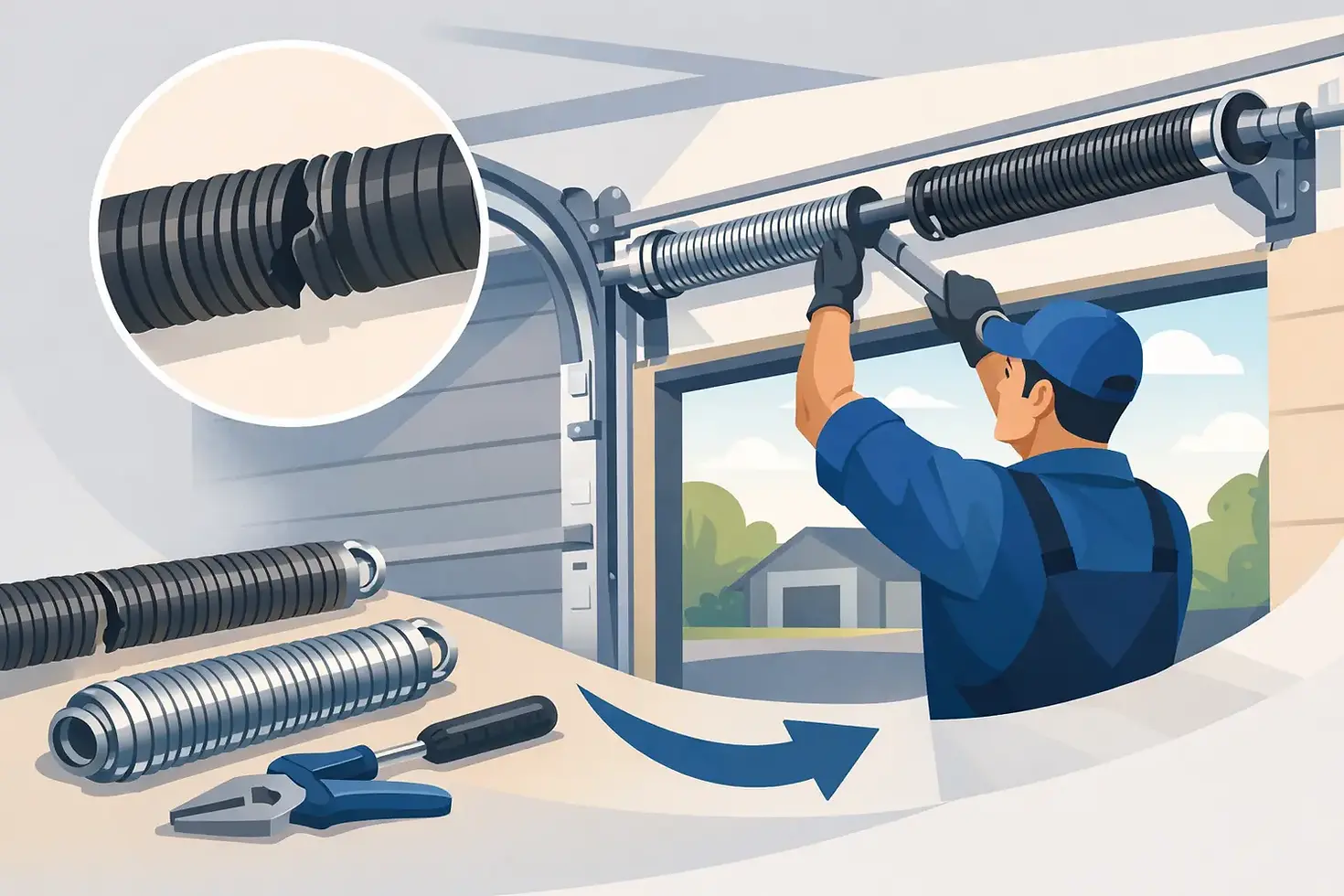
You should also look at how the door sits. If one side hangs lower, the springs may be uneven or one extension spring may have failed. If there is a visible gap in a torsion spring, it is broken and needs replacement. Rust, stretching, and separation are also red flags.
Why you should not wait
A weak spring does not just make the door annoying. It makes the system unsafe. The opener can burn out from overwork. Cables can jump, fray, or snap. Rollers and hinges take extra stress. The door can come down too fast or get stuck half open, which is bad for security and even worse in bad weather.
Waiting usually makes the repair bigger. What starts as a spring issue can turn into an opener issue, a cable issue, or track damage if the door keeps being forced. That is especially true for heavier insulated doors and commercial overhead doors where every component depends on proper spring tension.
If the door is already acting up, this is the time to shut it down and get it checked. Same-day service matters here because garage door problems do not stay small for long.
Torsion vs. extension springs
Most modern homes have torsion springs mounted above the garage door opening. These are generally more durable, more controlled, and better for heavier doors. Extension springs run along the horizontal tracks and stretch as the door moves.
Both types wear out, but the warning signs can look a little different. Torsion spring failure often shows up as a door that will not lift, a visible split in the spring, or a loud snap. Extension spring problems may show up as uneven lifting, a crooked door, or obvious stretching and slack.
No matter the type, spring replacement is not a casual DIY job. These parts are under serious tension. A mistake can cause major injury or damage fast.
Should you replace one spring or both?
If your door has a two-spring system and one breaks, most of the time both should be replaced. Here is why. Springs on the same door usually have the same age and cycle count. If one has failed, the other is usually not far behind.
Replacing both keeps the door balanced and saves you from paying for another service call in the near future. It also reduces uneven strain on the opener and hardware. There are exceptions, but in the field, replacing the pair is usually the smarter move.
For property managers and commercial owners, this matters even more. Downtime costs money. A second failure a week later is not a savings.
How to tell if the springs are just worn or fully broken
A fully broken spring usually stops normal operation right away. The door may not open at all, or it may only rise a few inches. With torsion springs, you may see a gap in the coil. With extension springs, one side may hang loose.
Worn springs are trickier. The door may still open, but slowly. It may drift down when left halfway open. It may slam shut harder than usual. The opener may sound strained. The door may also shake or vibrate more because the balance is off.
This is where a hands-on inspection matters. A trained tech can check spring tension, balance, cable condition, and whether the springs are the correct size for the door. Sometimes the issue is obvious. Sometimes it is a combination problem that starts with worn springs and ends with other hardware taking the hit.
What affects spring life
Usage is the big one. If your household opens the garage door six or eight times a day, spring life will be shorter than in a low-use home. Temperature swings around St. Louis do not help either. Metal expands and contracts, and older springs get brittle.
Door weight matters too. Wood doors, insulated steel doors, and oversized doors put more demand on the spring system. Poor installation can shorten lifespan fast if the springs were not matched to the door weight. Lack of maintenance also plays a role. Dry, rusty springs wear faster and put more friction into the system.
If you have had repeated issues with balance, cables, or opener strain, that is often a clue the springs were either aging out or never properly sized in the first place.
When replace garage door springs before they break
You do not always have to wait for a snap. If the springs are heavily rusted, showing visible wear, losing balance, or near the end of their expected cycle life, proactive replacement can save you a lot of trouble.
This is especially useful for busy households, rental properties, and commercial buildings where a stuck door becomes an immediate problem. Replacing worn springs before a full failure helps avoid emergency lockouts, opener damage, and doors getting trapped open at the worst possible time.
For customers who depend on the garage every day, planned replacement is usually cheaper and less disruptive than an after-hours breakdown.
Leave spring replacement to a pro
Garage door spring repair is one of the jobs that should stay off the weekend to-do list. Springs store enough force to cause serious injury if they are handled wrong. The danger is not just the spring itself. Winding bars can slip. Cables can whip. Doors can drop.
A proper repair means more than swapping parts. It includes matching the right spring to the door weight, setting the correct tension, checking balance, inspecting cables and drums, and making sure the opener is not already damaged from the strain. That is the difference between a quick patch and a repair that actually holds up.
At Davis Door Service, this is the kind of call we handle every day for homeowners and businesses across the St. Louis area. Fast response matters, but so does fixing the right problem the first time.
If your garage door is heavy, loud, uneven, or stuck, trust what it is telling you. Springs do not heal, and they rarely fail at a convenient time. Getting ahead of the problem is usually the fastest way back to a safe, working door.


Comments