


How to Test Garage Door Safety Before It Fails

A garage door can weigh several hundred pounds. If its safety systems are not working, it can close on a car, a pet, a child, or a person before anyone has time to react. The good news is that you can test garage door safety in a few minutes each month without taking apart the opener or touching high-tension parts.
These checks are simple, but they need to be done correctly. If your door fails any test, stop using it when possible and schedule repair before the problem turns into a dangerous breakdown.
How to Test Garage Door Safety at Home
Start with the door fully open and the area beneath it clear. Keep children, pets, vehicles, ladders, and stored items out of the test area. You should be able to see the entire opening and have access to the wall button and remote.
Do not test a door that is visibly hanging crooked, off its tracks, or supported by damaged cables. A door in that condition can move unpredictably. Call for service instead.
Test the auto-reverse system
The most important test checks whether the door reverses when it hits an object. Place a solid object, such as a 2-by-4 board laid flat, on the floor directly in the door's path. Do not use a hand, foot, trash can, or anything breakable.
Close the door using the wall button or remote. When the bottom section contacts the board, the door should stop and reverse back to the fully open position. It should reverse promptly, not keep pushing down on the object.
If the door does not reverse, the opener's force setting may be wrong, the travel limits may be out of adjustment, or the opener may have a mechanical or electrical issue. Do not keep experimenting with force settings if you are unsure. Too much closing force is a serious safety issue, and reducing it without addressing the cause can leave you with a door that will not close at all.
Test the photo-eye sensors
Most automatic garage doors have two photo-eye sensors mounted near the floor, one on each side of the opening. They send an invisible beam across the doorway. If something breaks that beam while the door is closing, the door should stop and reverse.
With the door open, press the remote or wall button to close it. As the door moves down, wave a broom handle or another long object through the sensor beam. Keep your body out of the doorway. The door should immediately stop and reverse.
If it does not reverse, first look for simple causes. Leaves, cobwebs, dirt, stored items, or a bumped sensor bracket can block or misalign the beam. Clean the lenses with a soft cloth and make sure both sensors face each other. A blinking or unlit sensor indicator is often a clue that alignment is off.
Do not bypass the sensors or hold down the wall button as a long-term workaround. That might get the door shut once, but it removes a major layer of protection. It also points to a problem that needs a real fix.
Check the door's balance
A garage door opener is designed to guide the door, not carry its full weight. Springs do the lifting. When springs weaken or break, the opener has to work too hard, increasing the chance of damage and unsafe operation.
To check balance, close the door and pull the emergency release cord to disconnect the opener. Only do this when the door is fully closed and you know how to reconnect it afterward. Lift the door manually to about halfway open, then carefully let go while staying clear of the opening.
A properly balanced door should stay near the halfway point. It may drift slightly, but it should not slam down, shoot upward, or feel extremely heavy. If it does, the spring system needs attention.
This is where homeowners and property managers should stop. Torsion springs and extension springs are under extreme tension. Never adjust, wind, remove, or replace them yourself. The repair may look simple online, but spring work can cause severe injury and door damage when done without the right tools and training.
Listen and watch during a full cycle
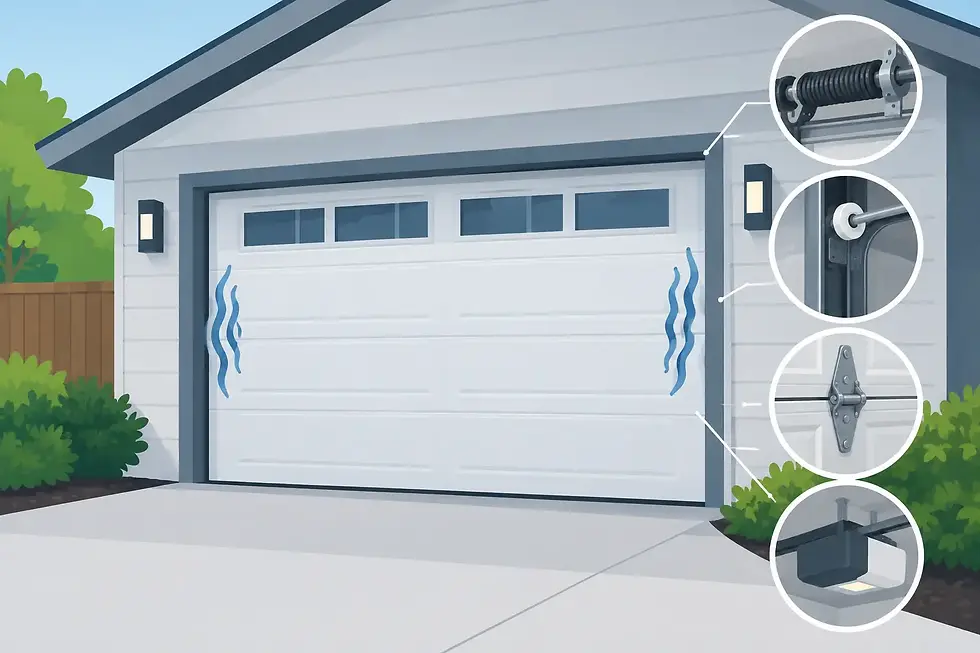
Reconnect the opener, then run the door through a full open-and-close cycle. Watch the rollers, hinges, tracks, cables, and bottom seal as it moves. You are looking for obvious changes, not trying to diagnose every sound.
Grinding, scraping, popping, or a loud bang are not normal. Neither are jerky movement, a door that shakes hard, rollers coming out of the track, loose cables, or a gap that appears between the door and the floor. A noisy door may only need lubrication or adjustment, but noise can also be the first warning of worn rollers, loose hardware, failing bearings, or a door that is starting to come off track.
Pay close attention to the cables. They should remain tight and evenly wound on the drums. If a cable is frayed, loose, or hanging off a drum, leave the door alone. Operating it can pull the door farther out of alignment.
Safety Checks That Take Less Than a Minute
Between monthly tests, take a quick look whenever you pull into the garage. Make sure the photo eyes are clear, the tracks are not blocked, and no tools, bikes, boxes, or seasonal items are in the door's path.
Check the bottom weather seal too. A torn seal is not usually an emergency, but it can let in water, pests, and cold air. More importantly, debris packed along the threshold can interfere with the door's closing position and sensor performance.
For homes with children, make sure remote controls are not left where kids can play with them. Wall controls should be installed high enough to be out of reach of small children and positioned where the operator can see the door moving. Teach everyone in the household one basic rule: never run under a moving garage door.
Commercial properties need the same basic checks, with more urgency. A roll-up or sectional overhead door that protects deliveries, equipment, vehicles, or staff should be inspected regularly because downtime affects more than convenience. If a commercial door starts binding, hesitating, or reversing unexpectedly, address it before it stops operations or creates an access problem.
When a Failed Test Means Stop Using the Door
Some issues can wait for a scheduled appointment. Others should be treated as a same-day repair call. Stop using the door and get help if the auto-reverse test fails, the photo eyes do not respond, a spring is broken, a cable is loose, the door is off track, or the door will not stay open manually.
You should also call when the opener strains, hums without moving the door, or opens the door only a few inches. Continuing to run it can burn out the opener and make a repair more expensive than it needs to be.
For St. Louis homeowners, a door stuck open also creates a security concern, especially overnight or when you need to leave for work. A door stuck closed can trap vehicles inside and disrupt a full day. Fast service matters because garage door problems rarely happen at a convenient time.
Davis Door Service handles safety-related repairs, including broken springs, snapped cables, opener trouble, sensor problems, off-track doors, and emergency service. An experienced technician can identify whether the issue is a simple adjustment, worn hardware, or a problem that should not be delayed.
Set a Simple Monthly Reminder
Put a recurring reminder on your phone for the first weekend of each month. Test the reversal system, test the photo eyes, look over the tracks and cables, and listen to one complete cycle. The entire process usually takes less time than loading the dishwasher.
That small routine gives you a chance to catch trouble before the door gets stuck, the opener fails, or a safety device stops doing its job. If something does not look or act right, trust that warning and get it checked before the next time someone walks or drives beneath the door.


Comments